Real Clock Numbers
Why clocks have 12 hours, English has eleven and twelve, and how the duodecimal system still haunts us today, and Pitman's numbers clock.
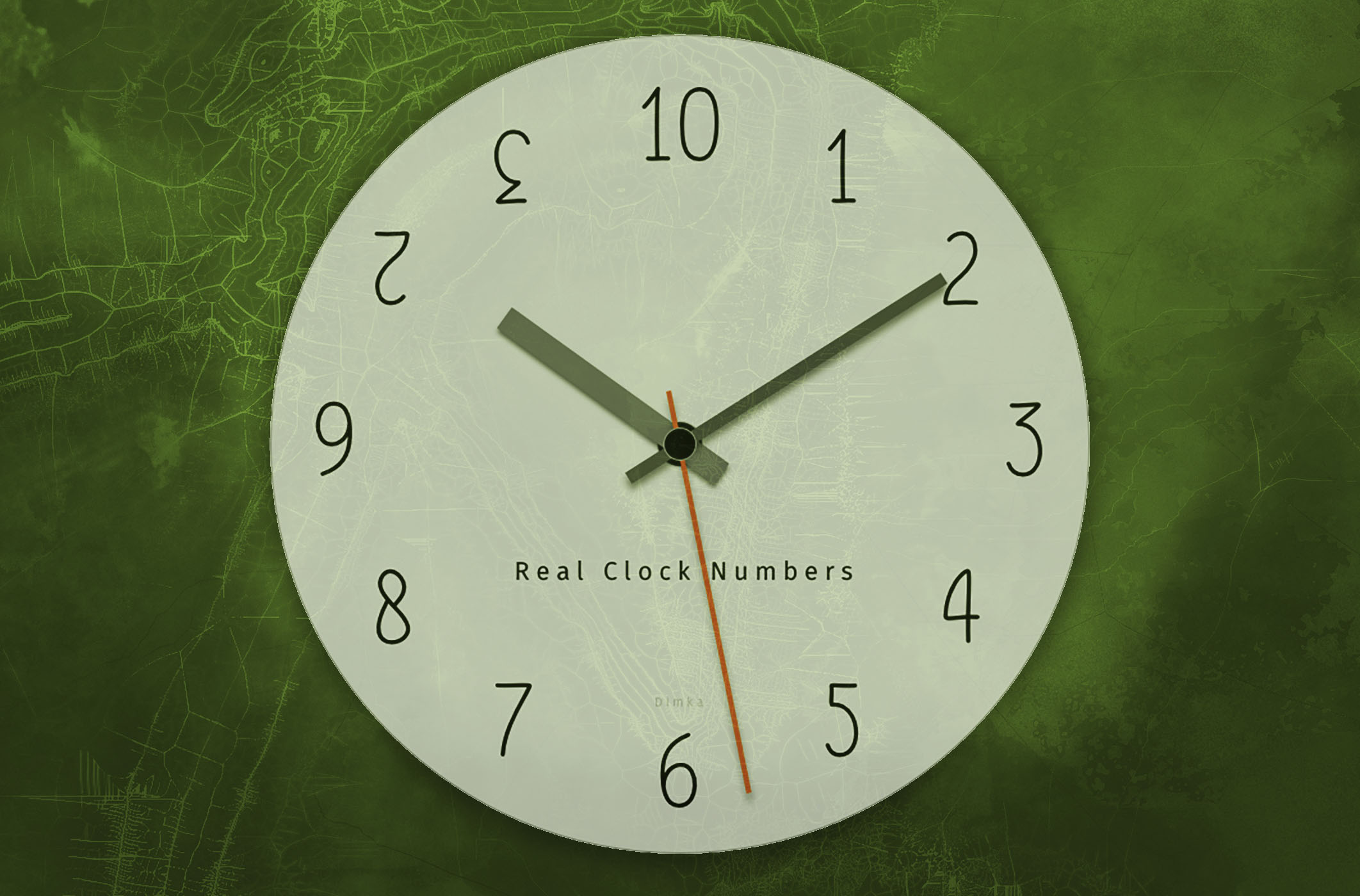
In ancient times, people used the duodecimal system—meaning there were 12 digits instead of our usual 10. Whether it's actually more convenient is up for debate; it has its pros and cons. 12 is divisible by 2, 3, 4, and 6, while 10 is only divisible by 2 and 5. But since we have 10 fingers, the decimal system eventually stuck. That wasn't the case from the very beginning, though.
This is why we still see the duodecimal system hanging on in certain areas. Take clocks, for example. You can also see it in the English language: numbers like 11 and 12 (eleven and twelve) look linguistically different from the rest because they originated from Nordic tribes who were using a base-12 system at the time. Then there's the "dozen," or the fact that there are 12 inches in a foot. Interestingly, the ancients used their fingers to count, too. If you use your thumb to count the phalanges (knuckles) on your other four fingers, you get exactly 12. And, of course, this pops up all the time in science fiction and even fantasy.
Our computers are binary—everything is zeros and ones—while the biological language of nature is quaternary; a DNA molecule consists of "words" made of three letters each, drawn from a four-letter alphabet. Yet, even in computers, not everything is binary. Things are often written in hexadecimal (hex), which uses 16 different digits. Since our alphabets usually only have 10 digits, the missing six are represented by the letters A–F. We see this in things like HTML color codes.
I've always found that a bit annoying: if we're using hex numbers, we should have hex digits. Officially, they don't exist. However, it turns out there are dedicated digits for the duodecimal system. A certain Mr. Pitman was a huge fan of base-12 and wanted unique digits for it; he actually succeeded in getting them added to the official Unicode standard. Ten looks like an upside-down 2, eleven looks like an upside-down 3, and twelve is written as "10."
In principle, since 6 and 9 are flips of each other and 8 and 0 are vertically symmetrical, we could probably just keep flipping the rest to get a full set of digits for the hexadecimal system too. But so far, no one has actually done it.
Tags: historymathinteresting