Quick start
- Goal: clear the whole board by removing tiles in matching pairs.
- Click or tap two identical free tiles and both disappear.
- A tile is free only when nothing lies on it and its left or right side is open — middle tiles must wait.
- Any flower matches any flower and any season any season; every other tile needs its exact twin.
- Stuck? Hint (H) shows a safe pair, Shuffle (S) remixes the tiles, Undo (Z) takes moves back — hints and shuffles count on the leaderboard.
The full rules
The goal
Clear the board by removing the tiles in matching pairs. Every deal on dimka.com can be cleared all the way — but taking the wrong pair early can still leave you stuck.
Free tiles
You can only take a tile that is free: nothing lies on top of it, even partly, and its left or right side is open. Tiles in the middle of a row wait until a neighbour on one side is gone.
 Free tiles: the two row ends and the tile on top can go; the covered tile and the ones boxed in on both sides can’t yet.
What matches
Identical tiles match: the same number of the same suit (Dots, Bamboo, Characters), the same wind or the same dragon. The four flowers all match each other, and so do the four seasons.
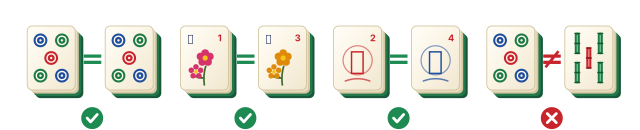 Pairs: identical tiles, any two flowers, any two seasons — but five dots and five bamboo are different suits and don’t match.
Hint, shuffle, undo
Hint shows a pair that keeps the board solvable when one exists. Shuffle mixes the tiles left into new places — usually into a solvable board. Undo takes back any number of moves, shuffles included. Hints and shuffles are counted on the leaderboard.
Three layouts
Turtle is the traditional five-layer pyramid of 144 tiles. Fortress is wide and low, with towers at the corners. Small has 72 tiles and fits a phone held upright. The first digit of a game number is its layout; the same number always deals the same board.
Options and keys
Highlight free tiles dims every tile you can't take yet. Simple faces add a big index to each tile — handy on small screens. Keys: H hint, S shuffle, Z or U undo, P pause, Esc clears the selection.
Table mode: four players
Switch to Table at the top of the page to play real four-player mahjong against three bots. Everyone holds 13 tiles. On your turn you draw a tile, then discard one. The first to complete a hand of four sets and a pair wins. A set is a chow (three in a row of one suit) or a pung (three identical tiles); four identical tiles make a kong, which earns an extra draw.
When someone discards, you may claim the tile: Pung or Kong if you hold a matching pair or triplet, Chow only from the player on your left, and Mahjong whenever the tile finishes your hand. A win beats a pung or kong, which beats a chow. Claimed sets are laid face up. If the wall runs out first, the hand is a draw. The dealer has the red wind marker; a match is one round of the winds (East) or a full game.
Hong Kong
144 tiles with flowers and seasons. A hand needs at least 3 faan to win. Faan come from a self-drawn win, a concealed hand, dragon and wind pungs, all pungs, flushes and more; your own flower or season adds one, and so does having no flowers at all. The payment doubles with each faan up to the 10-faan limit: the discarder pays double, and on a self-drawn win everyone pays double. The dealer keeps the deal after winning or a draw.
Riichi (Japanese)
136 tiles, no flowers, 25,000 points each. You need at least one yaku (scoring pattern) to win; dora add han but don't count as a yaku. With a concealed hand one tile from winning you can declare Riichi: it costs 1,000 points, locks your hand and counts as a yaku. You can't win on a discard while one of your winning tiles lies in your own discards (furiten). Points come from han and fu, with limits from mangan to yakuman. Left out: red fives, abortive draws and nagashi mangan; when two players could win on the same tile, the first in turn order takes it.
Chinese Official
144 tiles with flowers and 81 scoring patterns. A hand needs 8 points, not counting flowers, to win; each flower adds 1 point. On a discard the winner gets the hand's value plus 8 from the discarder and 8 from each other player; on a self-drawn win everyone pays the value plus 8. The deal passes every hand. Knitted hands are included; the account-once rule for small chow patterns is simplified.
Simplified
136 tiles, no flowers and no minimum: any four sets and a pair wins, and so do seven pairs and thirteen orphans. A win is worth 1 point plus easy bonuses for a self-drawn win, a concealed hand, dragon and wind pungs, all pungs and flushes. The discarder pays double; on a self-drawn win everyone pays double. A good way to learn.
Scoring patterns
The patterns of the rule set chosen on the table, with what each is worth. Native names are shown in small type.
