Mapping the Hierarchy of Uncertainty
From quantum indeterminacy and Brownian fluctuations to stochastic models, deterministic chaos, computational irreducibility, and entropy
In everyday speech, words like randomness, fluctuation, stochasticity, and chaos blur together as interchangeable synonyms. Across physics, mathematics, and computation, they form a structured architecture spanning microscopic scales, macroscopic dynamics, and the limits of observation.
Short Digest
In everyday speech, words like randomness, fluctuation, stochasticity, and chaos blur together, yet in science they form a structured ladder of scales and descriptions. At the bottom lies quantum uncertainty, an ontological randomness built into reality itself beyond instrument limits. One rung up sit thermal fluctuations and Brownian motion: molecular collisions whose jitter averages through the law of large numbers into macroscopic pressure and temperature.
Alongside them stands stochasticity, a deliberate modeling choice that replaces intractable microscopic detail with probability distributions. Nearby sits deterministic chaos, as in weather or the three-body problem, where exact, non-random equations still defeat long-term prediction because tiny starting errors grow exponentially. Framing the entire ladder are epistemic uncertainty (incomplete human data) and computational irreducibility (processes with no shortcut faster than step-by-step simulation), while entropy spans every level as a universal measure of disorder and missing information.
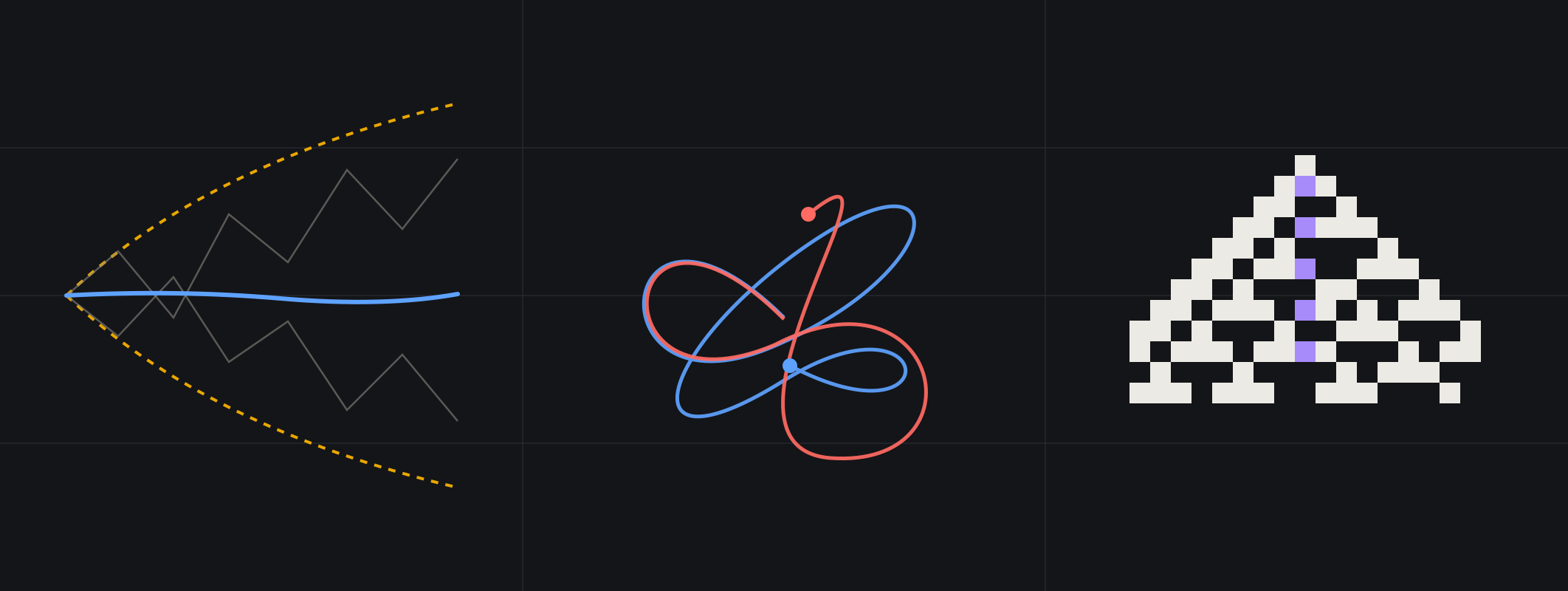
Interactive Three-Panel Simulation Lab
From Quantum Jitter to the Three-Body Problem
In casual conversation, our vocabulary for the unpredictable is remarkably loose. We talk about a chaotic schedule, a random coincidence, market fluctuations, an uncertain forecast, and rising entropy on a cluttered desk as if these words were interchangeable shades of the same fog. As everyday metaphors, that looseness causes no harm. Yet the moment we ask why a physicist calls the atmosphere chaotic, radioactive decay genuinely random, and a pollen grain's path in water stochastic, ordinary synonyms pull apart into distinct concepts.
Arranged carefully, these terms form an architectural hierarchy rather than a flat list. Moving from the bottom rung upward shifts the physical scale—from a single quantum particle, through trillions of colliding molecules, up to macroscopic nonlinear bodies. Flanking that vertical ladder are two boundaries imposed by the observer's own position inside the world: finite measurement precision on one side, and the speed limit of computation on the other. Tracing this map clarifies not only how nature behaves across scales, but also the exact linguistic boundary where one term must give way to the next.
Level 1: Quantum Uncertainty and Ontological Randomness
At the foundation of matter, classical intuition breaks down. When we flip a coin at a table, the outcome feels random only because we don't track the exact thumb impulse, rotational speed, and air currents. For centuries, it seemed natural to assume that the microscopic world worked the same way, waiting only for sharper instruments to reveal its hidden gears.
Formulated by Werner Heisenberg in 1927, the quantum uncertainty principle drew a hard boundary against that assumption. Conjugate physical quantities—such as a particle's position and momentum—cannot simultaneously possess exact values (Δx · Δp ≥ ℏ / 2). Crucially, this spread isn't caused by a clumsy microscope nudging an electron; it reflects ontological indeterminacy woven into reality itself. When a single photon hits a half-silvered mirror or an unstable nucleus awaits decay, quantum mechanics governs the evolving probability wave with mathematical rigor, yet no hidden mechanism pre-selects the individual outcome. Linguistically, quantum uncertainty belongs where randomness is primary and irreducible, persisting even for an idealized observer with flawless instruments.
Level 2: Thermal Fluctuations, Brownian Motion, and the Law of Large Numbers
Step up one floor from a single particle to a glass of water or a room full of air, where roughly 1023 molecules collide ceaselessly. Right at the border between the invisible micro-world and the visible macro-world, this restless crowd leaves a direct visual signature.
In 1827, botanist Robert Brown peered through a microscope at pollen grains suspended in water and saw them jiggling without pause; in 1905, Albert Einstein turned that curiosity into a quantitative theory of Brownian motion, providing decisive proof that atoms exist. Because a microscopic grain is small enough to feel slightly more molecular impacts from one side than another in any given instant, it lurches erratically. That momentary local imbalance is a thermal fluctuation.
Notice the linguistic anchor required here: nothing can fluctuate in a vacuum. The word fluctuation implies a stable baseline or equilibrium around which a value quivers. What builds that rock-solid baseline out of molecular bedlam is the law of large numbers, first proved by Jakob Bernoulli in 1713 and generalized a century later by Pafnuty Chebyshev. Across trillions of independent collisions, random left-right kicks cancel out, allowing statistical mechanics to distil microscopic disorder into dependable macroscopic laws of temperature and gas pressure. On this second rung, massed randomness doesn't destroy order—it manufactures it.
The Methodological Bridge: Stochasticity as a Probabilistic Lens
Where does stochasticity sit on this ladder? People often conflate it either with fundamental quantum randomness or with chaos, yet it occupies a distinct methodological perch beside the middle and upper rungs.
Suppose you want to model that jittering Brownian grain, network packet arrivals at a router, or electricity demand across a city. Writing Newton's equations for every water molecule or tracking every household switch is hopeless and uninformative. Instead, you make a deliberate modeling trade: sweep the uncounted microscopic degrees of freedom into a random noise term and describe how probabilities evolve over time. That mathematical object is a stochastic process.
Classic workhorses of this language include the continuous Brownian motion process and the discrete Markov chain, in which the probability distribution of the next state depends solely on the present state rather than the system's full history. Switching to the word stochastic isn't a metaphysical claim about whether the universe plays dice at the bottom; it signals an intentional shift in perspective, trading exact individual trajectories for tractable laws of probability.
Level 3: Deterministic Chaos and the Three-Body Problem
Whereas thermal fluctuations let the law of large numbers tame microscopic noise into macroscopic calm, the third rung stages the exact opposite drama. This is the realm of deterministic chaos—arguably the most frequently misused scientific term in everyday language.
Colloquially, chaos means lawless disorder. Mathematically, a chaotic system obeys strict causal determinism: its governing equations contain zero random variables and zero coin flips. Start the system twice from the exact same mathematical point with infinite decimal precision, and it will trace the exact same path forever. The catch is that physical reality never grants infinite decimal precision.
Studying the gravitational three-body problem in the late 1880s, Henri Poincaré discovered that even three masses obeying Newton's transparent law of gravity can weave non-repeating trajectories that defy closed-form prediction. Seven decades later, in 1963, meteorologist Edward Lorenz rounded inputs in a simplified weather convection model from six decimal places to three and watched the two forecasts diverge beyond recognition—a milestone in chaos theory immortalized as the butterfly effect.
Chaos is driven by nonlinearity and exponential sensitivity to initial conditions. Every chaotic system carries a characteristic predictability horizon (governed by its Lyapunov exponent): a few seconds for colliding billiard balls, roughly two weeks for synoptic weather, and millions of years for planetary orbits. That explains why stochasticity and deterministic chaos stand side by side without merging. A stochastic model injects probability into every step of the rule itself; a chaotic system runs on rigid deterministic rails, yet magnifies tiny starting blurs until its long-range behavior looks statistically indistinguishable from random noise.
The Side Walls: Epistemic Uncertainty and Computational Irreducibility
Stepping back from the physical rungs reveals two outer walls that frame the entire staircase—limits rooted not in atoms or planets, but in how an observer gathers data and computes predictions.
The first wall is epistemic uncertainty (from the Greek episteme, knowledge): our own incomplete data, finite sensor resolution, and rounding errors. In 1814, Pierre-Simon Laplace imagined a vast intellect—now known as Laplace's demon—for whom knowing every particle's exact state would erase all uncertainty about past and future. Epistemic uncertainty names our distance from that fiction. Once a flipped coin is slapped flat under your hand, physical indeterminacy is gone; the coin is already heads or tails, and the remaining uncertainty lives purely in your head. It is precisely this tiny epistemic blur in initial measurements that deterministic chaos amplifies into macroscopic unpredictability.
Yet suppose we eliminated both quantum indeterminacy and epistemic measurement error altogether: imagine a discrete grid of zeros and ones governed by a crystal-clear deterministic rule, with its starting row known with 100% accuracy. Could we always jump ahead and predict its distant future? Often, no. Here we hit the second side wall—computational irreducibility, developed by Stephen Wolfram in A New Kind of Science.
Traditional physics thrives on computationally reducible systems: an idealized pendulum lets us plug time t into an equation and leap straight to its millionth swing without tracing every oscillation in between. By contrast, many simple deterministic systems—Wolfram's famous example is the Rule 30 cellular automaton—admit no algebraic shortcut. Under computational irreducibility, finding the state after a billion steps requires executing all billion steps explicitly. When no calculation can outrun the system itself, prediction stalls even under complete knowledge of the rules and zero error at the start.
The Vertical Axis: Entropy Across Physics, Information, and Chaos
Where does entropy fit? Rather than occupying a single step, entropy acts as the vertical measuring tape running through the entire hierarchy, answering how much indistinguishability or missing knowledge a system holds.
Introduced by Rudolf Clausius in 1850 to state the second law of thermodynamics, thermodynamic entropy gained its microscopic meaning through Ludwig Boltzmann's equation S = kB ln W, which counts the logarithm of distinct microscopic arrangements W hidden behind one macroscopic state. Ink diffuses in water simply because mixed molecular arrangements vastly outnumber clumped ones.
In 1948, Claude Shannon founded information theory and uncovered the exact same logarithmic measure in communication: Shannon's entropy counts the average number of yes-or-no questions (bits) required to resolve epistemic or stochastic uncertainty about a message. Then, in 1959, Andrey Kolmogorov and Yakov Sinai bridged entropy directly to chaos: Kolmogorov-Sinai entropy measures the rate at which a dynamical system generates new information—equivalently, how fast it burns through our initial measurement precision over time. It equals zero for regular periodic motion, infinity for pure random noise, and a finite positive number for deterministic chaos, placing order, chaos, and randomness onto one rigorous mathematical scale.
Choosing the Right Term Across the Scale
| Term | Domain & Nature | Source of Unpredictability | When to Switch to This Word |
|---|---|---|---|
| Quantum uncertainty | Subatomic, ontological | Conjugate variables lack simultaneous exact values prior to measurement | When single-event randomness is intrinsic to nature, not instrument error |
| Thermal fluctuation (Brownian motion) | Mesoscopic ensembles | Momentary imbalance of molecular collisions around equilibrium | When a stable average exists via the law of large numbers and values jitter around it |
| Stochasticity | Probabilistic modeling lens | Uncounted hidden variables replaced by explicit probability distributions | When modeling state transitions probabilistically, such as a Markov chain |
| Deterministic chaos | Nonlinear dynamics (three bodies, weather) | Exponential amplification of tiny initial errors under causal determinism | When exact, noise-free equations still lose predictive power past a finite horizon |
| Epistemic uncertainty | Observer limitation | Incomplete data, finite sensor precision, or unmeasured state | When reality is already settled or fixed, and the gap lies in our knowledge |
| Computational irreducibility | Algorithmic ceiling | Absence of any closed-form shortcut faster than step-by-step evolution | When even exact inputs and deterministic rules require full simulation |
| Entropy | Cross-scale quantitative metric | Count of hidden microstates, missing information bits, or precision loss rate | When quantifying disorder, surprise, or forecast decay numerically |
Keeping these boundaries sharp pays off well beyond vocabulary hygiene: naming the obstacle tells you what tools can—and cannot—work. Epistemic uncertainty rewards sharper sensors and fuller data. Fluctuations yield to larger samples and averaging. Deterministic chaos warns us to stop chasing point forecasts past the Lyapunov horizon and switch to ensemble bounds and probabilistic risk corridors. And running into quantum indeterminacy or computational irreducibility reminds us that the universe isn't a textbook with an answer key printed at the back—some futures cannot be shortcutted ahead of time, only lived step by step.