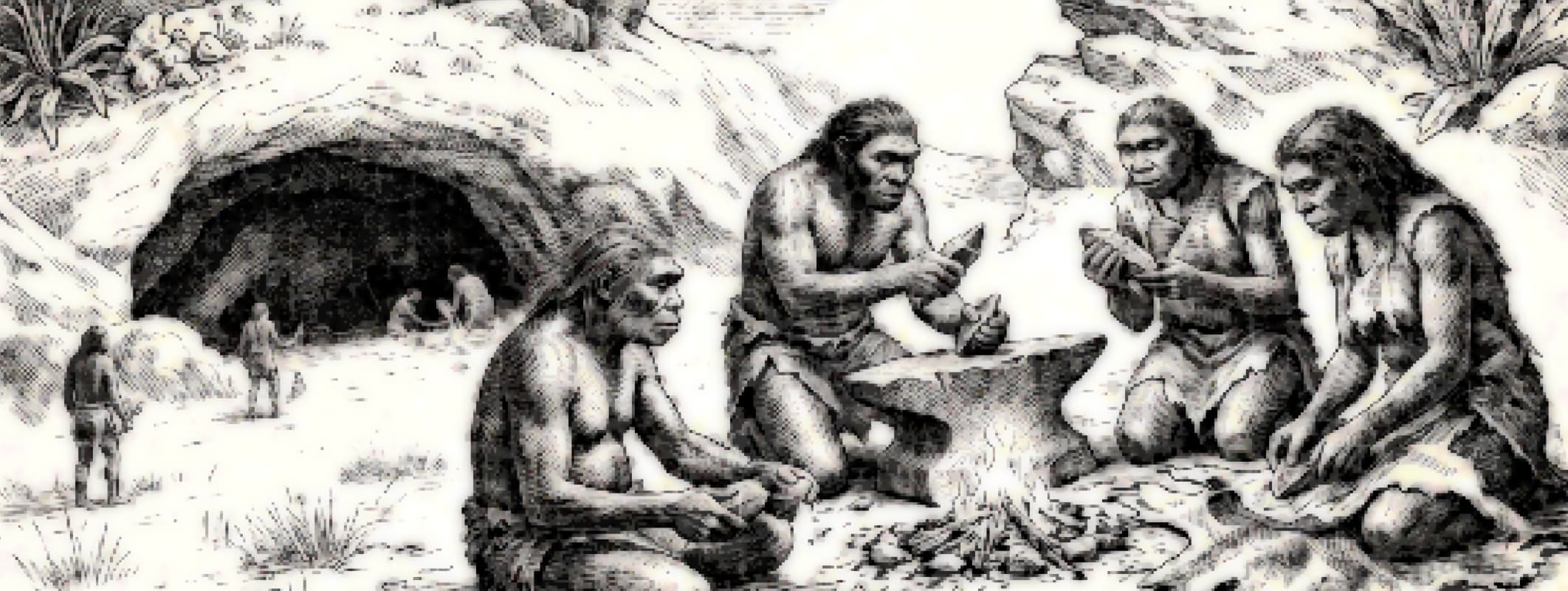
Major hominin species, timelines, nomenclature, and key innovations
A comprehensive reference chart tracking hominin evolutionary history from the Chimpanzee-Human Last Common Ancestor (CHLCA) to modern Homo sapiens, including transitional species, regional naming conventions, and technological milestones.
Paleoanthropological dates and brain volume estimates are based on current fossil record evidence and may adjust as new discoveries emerge.
Early Hominins & Australopithecines (7.0 – 2.1 Ma)
Species (EN)
Species (RU)
Time Period
Brain Volume
Key Characteristics
Sahelanthropus tchadensis
Сахелянтроп
~7.0 – 6.0 Ma
~350 cc
Close to CHLCA; forward-placed foramen magnum indicating upright standing; ape-like brain size.
Ardipithecus ramidus
Ардипитек
~4.4 Ma
~300 – 350 cc
Facultative biped with a grasping big toe; reduced canine size hinting at lower intra-group aggression.
Australopithecus afarensis ("Lucy")
Австралопитек афарский
~3.9 – 2.9 Ma
~400 – 500 cc
Fully committed habitual bipedalism; retained curved fingers for tree climbing; high sexual dimorphism.
Australopithecus africanus
Австралопитек африканский
~3.3 – 2.1 Ma
~450 – 500 cc
Slightly larger braincase and rounder cranium than afarensis; famous "Taung Child" fossil discovery.
Archaic Homo & Regional Lineages (2.4 Ma – 110 ka)
Species (EN)
Species (RU)
Time Period
Brain Volume
Key Characteristics
Homo habilis
Человек умелый
~2.4 – 1.4 Ma
~600 – 650 cc
First widespread production of stone tools (Oldowan tradition); flatter face and smaller molars.
Homo erectus
Человек прямоходящий / Питекантроп / Синантроп
~1.9 Ma – 110 ka
~900 – 1100 cc
Controlled use of fire; Acheulean handaxes; first hominin expansion out of Africa across Eurasia.
Homo antecessor
Человек-предшественник
~1.2 Ma – 800 ka
~1000 cc
Early European hominin; modern facial structure integrated with an archaic skull shape; cut-marked bone butchery.
Middle to Late Pleistocene Hominins (700 – 30 ka)
Species (EN)
Species (RU)
Time Period
Brain Volume
Key Characteristics
Homo heidelbergensis
Гейдельбергский человек
~700 – 200 ka
~1200 cc
Direct ancestor of Neanderthals and Sapiens; coordinated big-game hunting with wooden spears; built simple shelters.
Homo rhodesiensis / Homo helmei
Родезийский человек / Архаичный Homo sapiens
~300 – 200 ka
~1300 cc
African transitional form bridging H. heidelbergensis to anatomically modern humans; Levallois tool culture.