Three doors
The Monty Hall problem is statistically simple, yet it stumps smart people. Why doubts and social fears drown out a clear 2/3 answer.
There is a famous statistics puzzle called the Monty Hall Problem. The puzzle is quite old, of course, but it has gained popularity in our time because it frequently stumps smart and educated people. There was a mathematician named Steve Selvin who sent it to a journal in 1975. He framed it into a simple and relatable scenario based on a game show hosted by Monty Hall himself.
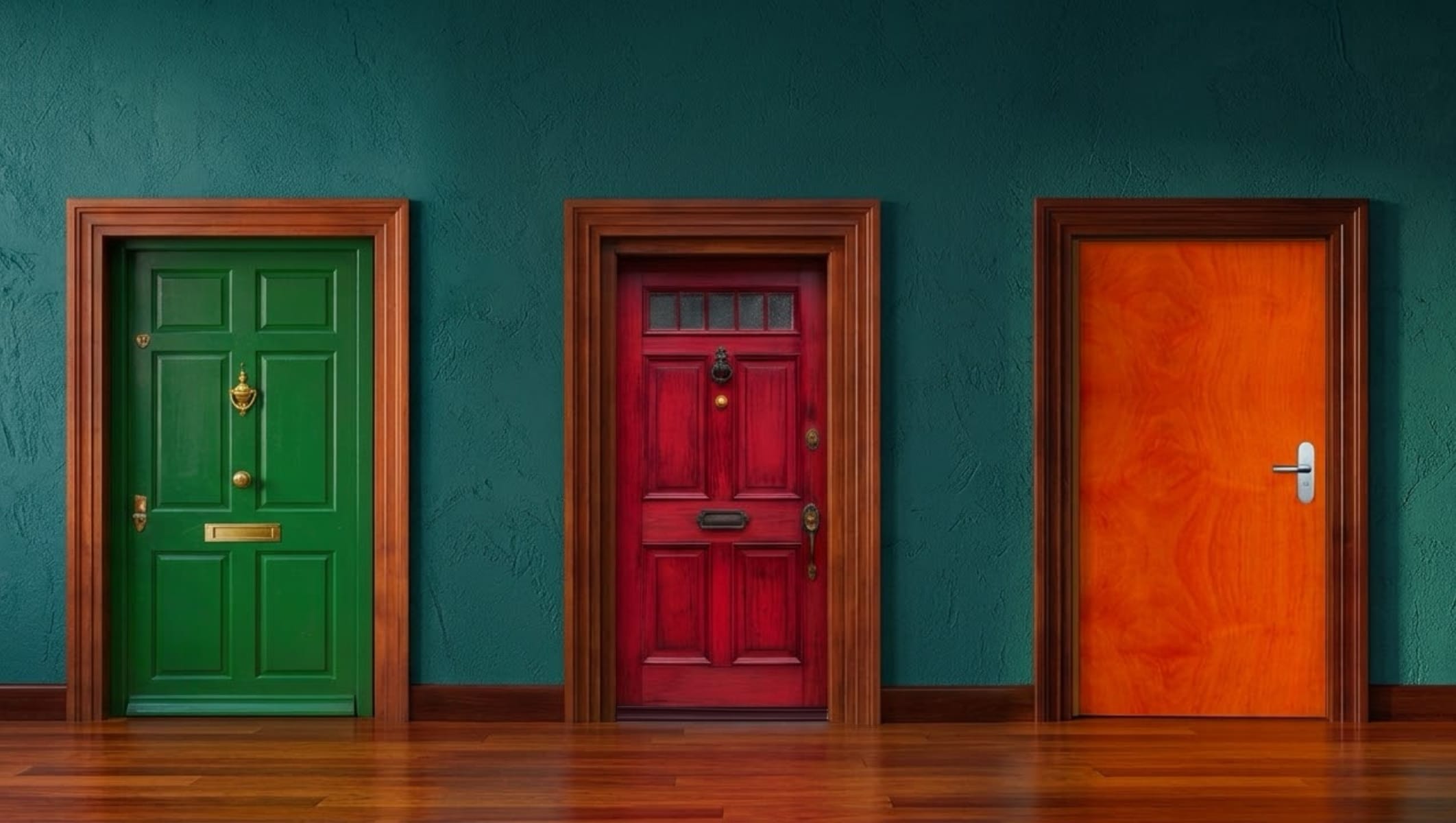
There are three doors. Behind one of them is a prize, a car, and behind the other two are goats. The player chooses one of the doors, but before they are told if they guessed correctly or not, the host, Monty, opens another door that they did not choose, and there is a goat behind it. And here is the question! At this moment, the host offers you to change your choice. Should you switch?
From a statistical perspective, everything is elementary here. Of course you should. But why does this stump so many people who start arguing that you shouldn't or that it doesn't matter to switch, claiming that the remaining odds are now 50/50 anyway? I think this is a modern problem for smart people. Woe from wit, so to speak. Doubts create so much noise that they interfere with calculations.
First, let me explain why the answer is more or less obvious. When a door is chosen at the beginning, the probability of guessing right is 1/3. So far, so logical. This means the probability that the prize is in the other section, behind the doors you didn't choose, is 2/3.
At this point, you can mentally divide these doors into two groups. In the second group, the probability is twice as high as in the first, and there are twice as many doors there, which seemingly balances the probabilities. But now, when the host opens one of those two doors in the second group, the number of unopened doors there decreases. It turns out we still have two groups, but in the first one, the probability is one-third, and in the second, it is two-thirds. But now we know for sure that there is only one door left in the second group. Therefore, by changing your choice at this moment, you double your probability from one-third to two-thirds. And that is exactly why you need to switch.
But the world is complex. The first doubt that might arise is that the host knows where the prize is and is deliberately tricking you. Life teaches us this. There is always a catch in such games. Why would he offer something good? They clearly want to fool you. The answer to this is that, according to the rules of the problem, the host will offer you to switch doors regardless of whether you guessed correctly or not. If you guessed right, he doesn't care which door to open. But if you guessed wrong, he is strictly obligated to open only the one with the goat. The probability that he doesn't care is one-third. In principle, this is a valid concern, but you can ask a question about it. And they will assure you that it doesn't matter whether you guessed right or not, they will still offer you to switch doors.
It might also seem that since you don't know yet, it doesn't matter which of the remaining two closed doors to choose, claiming the chance is 50/50. And your intuition to be on alert and wary of scammers will push you not to change your choice, since it is 50/50 anyway. But it is not 50/50, because the host did actually open a door and didn't just offer to change your choice. And he didn't open a random door, but the one where he knew there was no prize.
All these doubts stump people, making them hesitate and stop thinking about statistics. This is especially true since most people are already so bad at math that it is socially acceptable to brag about being bad at basic arithmetic, let alone puzzles like this. This is sabotage and a failure of the education and upbringing system. At the same time, humanities-minded people can easily shame you for messing up some grammatical rule that is not logical at all, doesn't really affect the meaning, and simply needs to be memorized.
Overall, this is a puzzle where the simple, correct answer is deliberately hidden behind the bushes of our social fears. But it is only hidden for tech-minded people who can calculate but have issues specifically with this social aspect. For others, it is hidden behind deep ignorance and gaps in basic education. And it is not even clear which is worse.
Tags: mathpsychologysociety