Data-Centers Struggles

Posted on 2026-06-07 by Dmitri Zdorov

data-centers struggles

In our TechLife Podcast (we are working on making it available in English, soon, but not there yet), Vasily and I discussed how the recent wave of public protests against new AI data centers is largely driven by a mix of surface-level environmental anxieties and much deeper economic fears. While critics heavily target the massive water and electricity consumption of these facilities, this outrage is often entirely disproportionate when you compare it to everyday resource drains like growing almonds or filling residential swimming pools. Ultimately, these environmental arguments usually mask a profound fear of the future. People are terrified of losing their livelihoods to automation, echoing the job losses seen during past globalization waves, and they feel powerless against a future potentially controlled by a small tech oligarchy. There is also a very real possibility that these local panics are being deliberately amplified by foreign geopolitical rivals through algorithmic platforms like TikTok to intentionally slow down Western technological dominance.

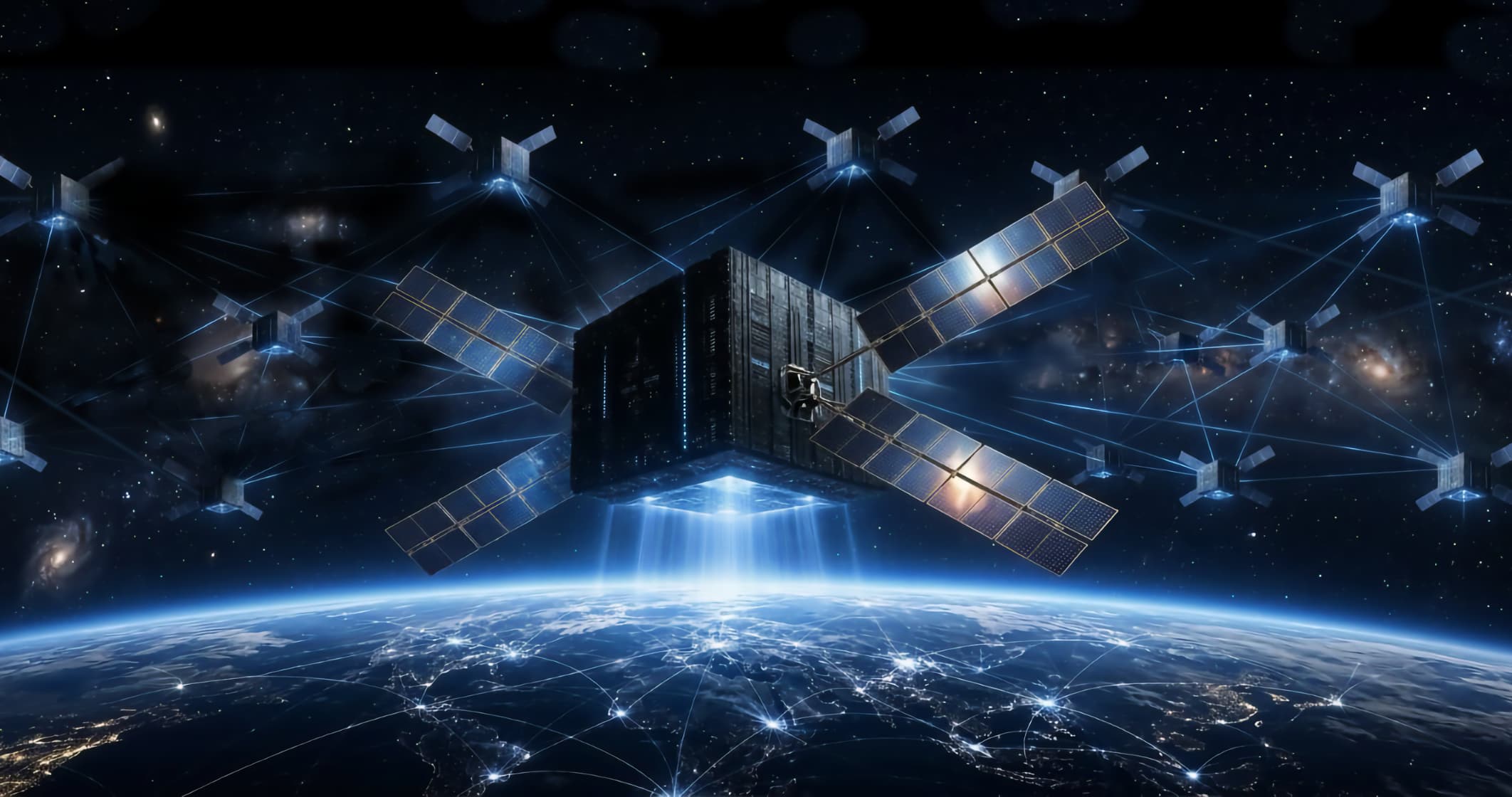
To overcome this public resistance, tech companies face a few choices, for example they could simply pay local residents a direct stipend to win their approval, or explore extreme alternatives like building data centers in space or in completely different countries. However, the physical location of a data center actually depends entirely on its specific technical purpose. Facilities built for training models require massive, densely packed GPU clusters and enormous power, but they can realistically be built anywhere in the world like Greenland, Australia or somewhere it's not hard from the regulatory point of view, because they don't need to communicate with end users. Conversely, inference centers must be built very close to the people using the models to eliminate latency, operating very much like content delivery networks for streaming video. The biggest challenge ahead will be the third category: facilities dedicated to AI agents communicating autonomously with other AI agents, which will inevitably become the most massive and resource-hungry data centers of all, those can be build anywhere, where it can just reliably powered and accessed electronically.

This is mostly about the US of course, but it will basically affect everyone. The situation is global.

AI development is moving incredibly fast, noticeably faster than other similar technological milestones. And while at first the growth bottlenecks were the technological approaches, research, and model development, it later temporarily hit a wall needing much larger financial investments. That issue was resolved almost instantly against the backdrop of the hype and off-the-charts demand. Now it has all hit growth limits tied to scaling in the physical world.

The situation here is immediately obvious. There's a shortage of various types of electronics themselves, like chips and memory, as well as the physical spaces to install them all, and then the resources they consume. In this massive spectrum of lagging supply chains, data centers are just one of many deficits, but they sit right in the middle.

Here's an interesting aspect. If we assume this is a bubble and this bubble bursts (which isn't a given, but let's assume), bubbles actually have a certain utility. They drive massive investments into infrastructure that will continue to be used long after the bubble pops. In this case, it's things like electricity generation, which is a fundamentally crucial thing. If it weren't for the exaggerated fear of nuclear power plants that started about 40 to 50 years ago, and if nuclear energy had developed as rapidly as other tech sectors, it's hard to even imagine what kind of world we'd have right now. For example, with much cheaper and more accessible electricity, we'd need far less coal and oil. We could desalinate salt water to irrigate massive territories, while transportation, manufacturing, construction, and of course computing would become significantly cheaper. It turns out this fear set humanity's development back by many decades, but now, thanks to the insane demand for energy for data centers, this issue will be resolved across several fronts at once. And even if the bubble bursts, the massive benefits will remain.

However, increasing power generation is just one of many pluses. Creating the models themselves is obviously another huge benefit, and the same logic applies here. Even if everything crashes, even the current models are so heavily underutilized in the global economy that reaping the rewards of implementing them in various ways will last us for decades.

So we can see that having development across all these necessary areas is extremely important for the economy. It brings incredible technological, economic, and consequently military advantages. It's unclear whether the new models will reach a level where old cybersecurity methods are simply powerless against them, though we are getting pretty close to that. If they do, it will simply be the end of the nuclear threat from countries without such capable models. But even without that, we are already seeing how the use of these models brings a significant edge right on the battlefield. Through autonomous drones, electronic warfare, reconnaissance and targeting, or simply by boosting the productivity of the defense industry.

As the capability gap widens, countries that will start losing their traditional forms of deterrence (actually, even those two countries that aren't losing them yet) will be thinking very hard about how to destroy these capabilities in others. You can bomb chip manufacturing plants, but that's a strike against the future. Bombing data centers — that is a strike against realized capabilities.

That's why the idea of launching data centers into space, and maybe chip manufacturing too, is completely justified. They won't just be flying around up there as a few large, vulnerable targets. They will be distributed across a massive number of units placed quite far apart, and shooting them down piece by piece would be very difficult. Another direction that I think will inevitably follow is mass underground construction. This also offers huge advantages. First, it's hard to destroy. Second, digging deep takes up less surface area and is less of an eyesore, which means fewer protests. It's more expensive, but ultimately it will become necessary. The main advantage of space compared to underground options is communication and energy supply. Both are much more convenient in space. On the other hand, underground gives you better radiation protection and easier maintenance, and with the development of nuclear energy, even power won't be an issue.

But the fear of AI keeps popping up again. I think the main mistake right now is our tendency to anthropomorphize AI.

It's similar to how people 200 years ago might have been scared by "some kind of technical progress" or "electrification" or even industrialization, treating them as if they were villains with a face, united in their intentions, and so on. AI is an entire stratum of various things, and within this stratum there are plenty of separate risks with a wide spectrum of ways to mitigate them. And the main thing is that we still have to get to that point, and the need for massive development stands in the way.


Primavera

Posted on 2026-06-01 by Dmitri Zdorov

Primavera

A long time ago, when I was still a fresh-faced immigrant and didn't know the many subtleties of how even the most standard things can actually differ, I walked into my classroom at the Art Institute of Boston and told all my classmates, "Happy first day of spring, everyone!" But they reacted weirdly. That was the moment I found out that spring doesn't start on March 1st everywhere. It certainly helped that back in my high school astronomy classes, I had learned about the concept of astronomical seasons, and it turns out that here in the States, seasons are defined exactly that way.

This seemed terribly inconvenient and crooked to me, much like the imperial system with its feet, pounds, and Fahrenheit. Although in this case, it's actually somewhat closer to Kelvin. So, spring starts not on March 1st, but on the vernal equinox, and summer on the summer solstice, and so on. But it's not that simple. Because these astronomical events don't happen on the same calendar day every year. Some years it's March 20th, and some it's the 21st. And autumn, for example, isn't September 20th or 21st, no. Autumn is the 22nd or 23rd. Yeah, science!

But everything has an explanation, of course. America, as an heir to Europe, calculates seasons exactly this way, and over there in Europe, it's actually more convenient to count them like this not because of astronomy, but mostly because of the Gulf Stream, which delays all the seasons. And the dates jump around because of the so-called tropical year. The Earth makes a full orbit around the Sun in 365 days, 5 hours, 48 minutes, and 46 seconds—that is the tropical year. Meanwhile, our calendar year is 365 days, with a leap year every four years, except once every 100 years when the leap year is skipped, except once every 400 years when it isn't. Not everyone caught onto these subtleties at the same time, which is why Russia has the Old New Year, and the October Revolution actually happened in November.

But the reality on the ground is even more complicated.

So, there are countries where seasons are defined astronomically. And then there are those where they go by full months starting on the 1st—this is called the meteorological (or sometimes calendar) system. Turns out, it's not just used in the post-Soviet space, but also in places like Australia, New Zealand, and South Africa. And it's also the standard among climatologists and various other scientists whose work has anything to do with seasons, because it's simply more convenient and precise.

But wait, there's more. Seasons can be divided not only by the calendar or astronomy. There is also a third system. In East Asian countries, like China, Korea, and Japan, they use a system of solar seasons, where an astronomical event like the vernal equinox falls exactly in the middle of the season. Because of this, their spring actually begins in early February, and their summer is already underway by early May.

Long story short, it's a bit of a mess. And by the way, the Earth actually completes a full rotation on its axis not in 24 hours, but in 23 hours and 56 minutes. The extra four minutes are spent turning to face the Sun with the exact same spot as the day before.

But I also really love the six-season system that Kurt Vonnegut described in his essay collection Palm Sunday:

"Here is the truth about the seasons: Spring is May and June. What could be springier than May and June? Summer is July and August. Really hot, right? Autumn is September and October. See the pumpkins? Smell those burning leaves? Next comes the season called Locking. November and December aren't winter. They're Locking. Next comes winter, January and February. Boy! Are they ever cold!

What comes next? Not spring. 'Unlocking' comes next. What else could cruel March and only slightly less cruel April be? March and April are not spring. They're Unlocking."

He nailed it perfectly. I couldn't agree more. Happy middle of spring, everyone! ))

Parent of the soul

Posted on 2026-05-16 by Dmitri Zdorov

Parent of the soul

I was out walking the other day, just wandering around. And somehow, my thoughts led me to an idea. Hear me out. Every person has parents who gifted them their share of genetic material. Then, there are external circumstances, including the world around us, how these parents, or maybe not even these parents raise them, how a given personality navigates all sorts of hardships and challenges, dreams, infatuation, disappointments, etc.

But also, in religious circles, it's customary to talk about the soul. Whether it exists or not, we don't know for sure. Even some stubborn materialists sometimes have doubts about this. Well, let's say there is a certain virtual, emergent prototype that combines a person's inner world, shaped by this genetic heritage and environmental influence, which anthropomorphically represents the consciousness of this individual. Throughout my life, I've encountered many different models of abstraction, starting with ones from higher mathematics, and later as a designer working with user personas and their groups, as an IT professional working with virtual machines, and so on. It's easy for me to imagine that what people commonly call the "soul" is just a collective abstract "something" that a person feels but doesn't quite know how to describe properly.

So, the idea is that this anthropomorphic soul also has a parent of its own. Something like grand collective, like ancestral memory, epigenetic cues, and cultural codes embedded deep in the subconscious. "It" — this parent of the soul — teaches and nurtures our soul. Apparently, it takes the form of "talking" conscience.

What's the right name for it: archetypes, Super-Ego, the collective unconscious, egregore, daimonion, Anima Mundi, epigenetic memory, memetics — I don't know. There is no established term for this. So, I'd call it Atmajanaka (Sanskrit for "sourse of the soul").

Rubicon of Cognition

Posted on 2026-03-19 by Dmitri Zdorov

Rubicon of Cognition

Over time we accumulate a better understanding of what is happening. And this happens mostly through the combination of three directions:

  1. New knowledge,
  2. deeper and more detailed grasp of already mastered knowledge,
  3. and the third, a new level of abstraction, that is, conclusions drawn from the awareness of everything, very often from several different segments of our knowledge at once, conclusions that overall lead us to these emergent insights.

It can also be pictured as expansion, deepening, and synthesis (which is precisely what I consider the new level of abstraction, i.e., discoveries).

In essence humanity already knows quite a lot. And when we as a civilization develop, we mostly draw on the accumulated knowledge and there is an enormous amount of it. Life experience, wisdom, practice certainly give depth, but that alone is still not enough for creating genuinely new knowledge. New knowledge becomes possible only through a new level, thanks to emergence and in no other way.

The real question of creating AGI is exactly this: teaching models to draw new conclusions by aggregating and analyzing already known information. So far it's proceeding slowly and laboriously, yet examples already exist, just very modest and insignificant ones. And for many people it remains an open question whether models will ever be able to achieve this.

Because this is the best way to understand whether there is some form of mind in there, or whether it's only algorithms. After all, consciousness and reason are exactly what is required for the synthesis of information, one could say for making scientific discoveries and rolling out new technologies.

And as soon as models learn to give explanations of accumulated knowledge at these new levels of abstraction, they will immediately become incomparably, by orders of magnitude, more efficient. Because then it will no longer be necessary to memorize gazilobytes of trivial facts; instead it will be possible to rely simply on general principles, logic, and a handful of examples.

Chasing butterflies

Posted on 2026-01-21 by Dmitri Zdorov

Chasing butterflies

I was just trying to tend my garden and not ruin the beautiful view and a lovely metaphor drifted in from the internet:

The secret is not to chase butterflies… it's to tend to your garden, and they will come to you. And even if they don't, you'll still have a beautiful garden.

It's a modern meme, pieced together from a supposedly German proverb (whether that's true or not is unclear): "Das Glück ist ein Schmetterling. Jag ihm nach, und er entwischt dir. Setz dich hin, und er lässt sich auf deiner Schulter nieder." (Happiness is a butterfly. Chase it, and it eludes you. Sit down quietly, and it settles on your shoulder.)

It also seems to be frequently misattributed to the Englishman Nathaniel Hawthorne, likely because it appeared in an 1891 book of quotations where his name was printed right next to the phrase.

But later, it was rephrased more beautifully by the Brazilian poet Mário Quintana (1906–1994):

"O segredo é não correr atrás das borboletas... É cuidar do jardim para que elas venham até você." (The secret is not to chase the butterflies... It's to tend the garden so that they come to you.)

Real Clock Numbers

Posted on 2025-12-31 by Dmitri Zdorov

Real Clock Numbers

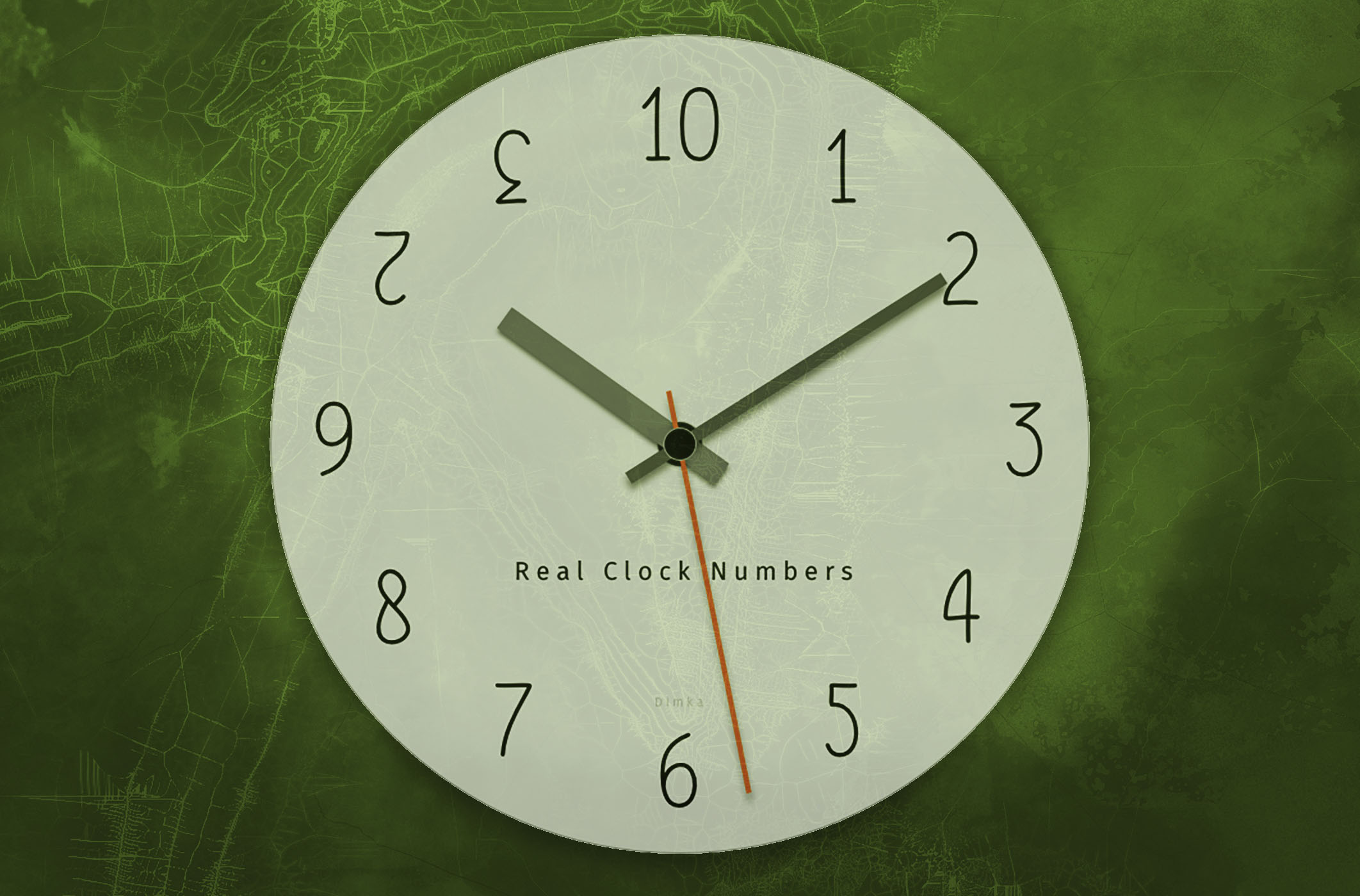
In ancient times, people used the duodecimal system—meaning there were 12 digits instead of our usual 10. Whether it's actually more convenient is up for debate; it has its pros and cons. 12 is divisible by 2, 3, 4, and 6, while 10 is only divisible by 2 and 5. But since we have 10 fingers, the decimal system eventually stuck. That wasn't the case from the very beginning, though.

This is why we still see the duodecimal system hanging on in certain areas. Take clocks, for example. You can also see it in the English language: numbers like 11 and 12 (eleven and twelve) look linguistically different from the rest because they originated from Nordic tribes who were using a base-12 system at the time. Then there's the "dozen," or the fact that there are 12 inches in a foot. Interestingly, the ancients used their fingers to count, too. If you use your thumb to count the phalanges (knuckles) on your other four fingers, you get exactly 12. And, of course, this pops up all the time in science fiction and even fantasy.

Our computers are binary—everything is zeros and ones—while the biological language of nature is quaternary; a DNA molecule consists of "words" made of three letters each, drawn from a four-letter alphabet. Yet, even in computers, not everything is binary. Things are often written in hexadecimal (hex), which uses 16 different digits. Since our alphabets usually only have 10 digits, the missing six are represented by the letters A–F. We see this in things like HTML color codes.

I've always found that a bit annoying: if we're using hex numbers, we should have hex digits. Officially, they don't exist. However, it turns out there are dedicated digits for the duodecimal system. A certain Mr. Pitman was a huge fan of base-12 and wanted unique digits for it; he actually succeeded in getting them added to the official Unicode standard. Ten looks like an upside-down 2, eleven looks like an upside-down 3, and twelve is written as "10."

In principle, since 6 and 9 are flips of each other and 8 and 0 are vertically symmetrical, we could probably just keep flipping the rest to get a full set of digits for the hexadecimal system too. But so far, no one has actually done it.

Who wants this?

Posted on 2025-11-22 by Dmitri Zdorov

who wants this?

Sometimes it feels like the world has gotten worse. Like it's gone bad somehow.

But the world is huge and complicated, and we can't really make those judgments objectively. Subjectively it's tricky too, yet within that subjectivity it often seems like things weren't this insane or even mad before.

Whether that's true or not — everyone decides for themselves. My own hypothesis, though, is that at some point the world genuinely started getting better, but that very improvement bred weak generations (I personally blame the boomers) who got too comfortable and complacent, that in turn cause the progress to start sliding backward.

And it's going to keep sliding back for a while. Whether it hits rock bottom, total horror, and catastrophe, or whether we as a civilization snap out of it and manage to turn things around — that's what we're about to find out.

To avoid sliding down a slope

Posted on 2025-11-20 by Dmitri Zdorov

To avoid sliding down a slope

My three rules for keeping my moral compass from drifting under the influence of propaganda, algorithms, and tribalism.

  1. Maintain sources from the opposite side of the spectrum, even when I disagree with them. It's best when these sources aren't just "the other side," but are reasonable and well-argued.

  2. Minimize algorithmic feeds. What I watch and read must be chosen manually; lists, sources, and feeds should be strictly curated.

  3. Keep a journal. This includes recounting events in detail and providing analytical reflections on what is happening.

After all: more languages or fewer?

Posted on 2025-10-17 by Dmitri Zdorov

After all: more language or fewer?

For many years, I've had this concept, or perhaps a hypothesis, that over the next few decades, the number of countries in the world will grow, while the number of living languages will shrink. This is because, for example, the world is becoming more globalized, and there's little need to speak smaller languages. They don't offer the usual financial or other advantages. World-famous novels aren't written in them, blockbuster movies aren't filmed in them, and groundbreaking scientific papers aren't published in them. And even if something like that happens on rare occasions, it's always translated.

But now, I'm starting to have doubts about this. If advancements in computer translation trigger a linguistic revolution, making all media, literature, and other information, whether spoken or written, accessible in a vast array of languages, and if it gradually becomes fairly easy to add more and more languages, dialects, and even slangs, then switching to some dominant, widely spoken language might actually become less strategically necessary. On the contrary, you could speak your native language, the one you've known since childhood, with the people around you physically, and everything else from the outside world would be available in that same language too.

If things head in this direction, we might see an explosion of new dialects and linguistic offshoots. If, instead of speaking in person, you constantly receive speech tailored specifically to you, translated into your preferred language and even fine-tuned to your personal tastes, then communication at the level of villages or neighborhoods might be more than enough for personal interaction, and beyond that, everyone's on equal footing.

Some social groups might quickly dive deep into their own slang, while others could start inventing new languages,artificial ones with enhanced linguistic possibilities. Radically reforming existing languages or creating entirely new ones from scratch wouldn't just be possible; it could even become accessible to small groups of people.

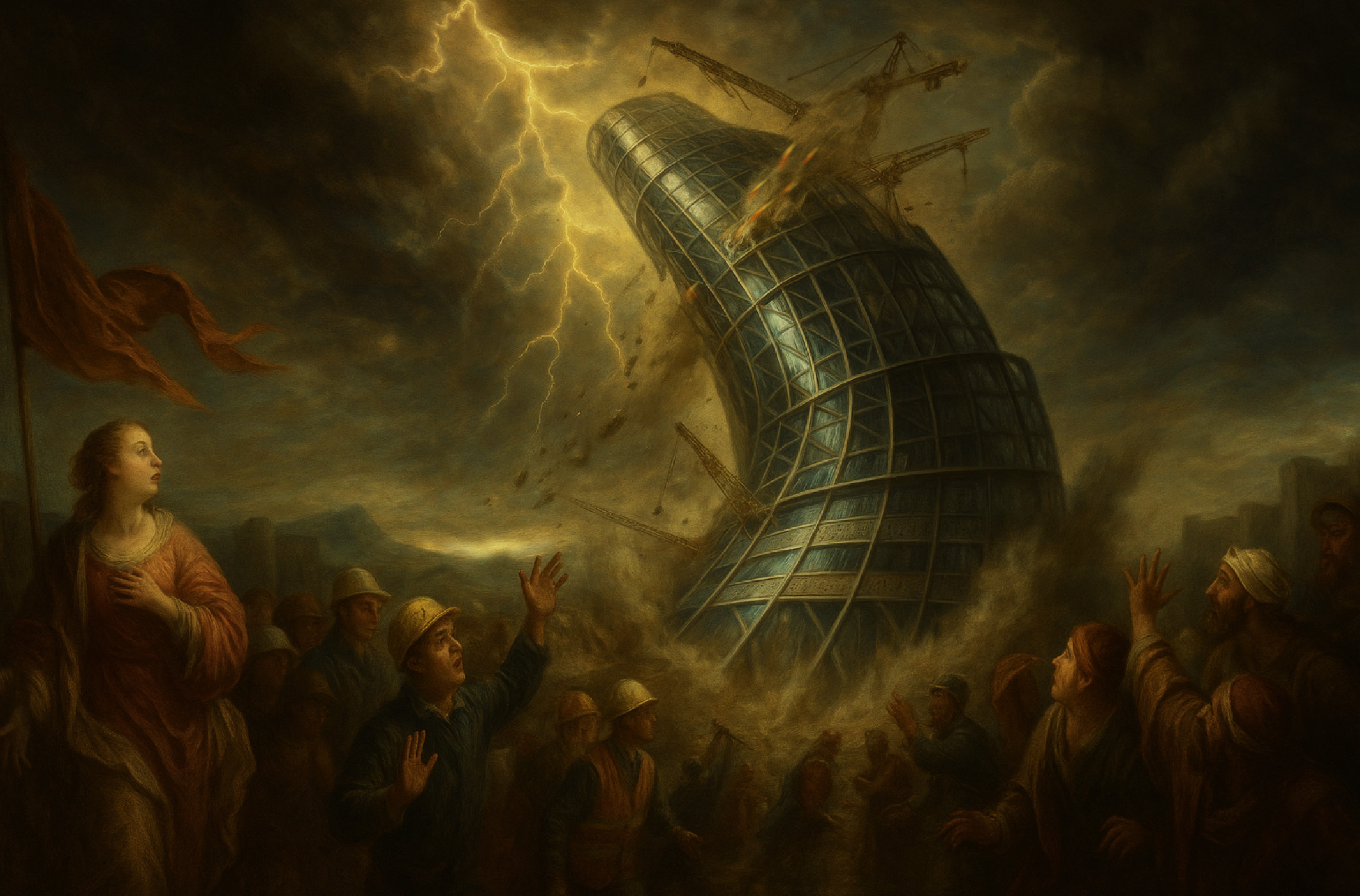
If this kind of multilingual explosion happens and then the system enabling all these automatic translations crashes—that would be the real fall of the "our" time's Tower of Babel. (In quotes, because it would still take a couple of generations.)

In the end, I believe both trends will coexist. Old languages will continue to vanish rapidly under the pressure of globalization, but translation technology will spark an explosion of new languages, most of which will be short-lived, such as digital slangs or niche dialects. A few, however, could be radically innovative, perhaps blending human and machine syntax or unifying diverse cultures in a hyper-connected world, offering greater precision and vibrancy while being simpler to learn and better structured for rapid processing. These languages, unimaginable today, would be tailored to future needs, such as AI collaboration or global governance, though their emergence may be limited by unequal access to technology. Still, I believe fewer languages would be beneficial. Fewer does not mean just one, but having hundreds or thousands of languages does not necessarily help humanity grow. Instead, fewer languages would create larger pools of speakers, fostering richer creative and educational material, better cross-country communication, and a larger body of easily accessible knowledge. Yet, no single language is perfect, so maintaining a small number of diverse languages would allow us to leverage the unique linguistic benefits and perspectives each brings.

There have been many attempts to create new languages, even long ago—think Esperanto, designed for global unity, Interslavic (Mežeslavjanskij), or Slovio and even Slovanština, all aiming to bridge Slavic tongues, or the inventive the Shavian alphabet, crafted for phonetic English. With technology lowering barriers, I believe we’ll soon see a surge of such experiments, and some might just take off.

Felidae - 1994 Animated Cat Thriller

Posted on 2025-10-08 by Dmitri Zdorov

Felidae - 1994 Animated Cat Thriller

Watched Felidae, a 1994 German animated feature film, a detective story about cats investigating murders.

It's well-made, interesting, and unusual. Generally, all the well-known, high-quality stuff has already been watched to death, and the less-watched stuff is usually of a lower tier. So, if you love Miyazaki, Tekkonkinkreet, Fantastic Planet, Watership Down or Paprika, this one's worth checking out too.

The premise is simple: a cat named Francis moves to a new place because his owner, who writes pulp novels, frequently relocates for inspiration. In this new place, Francis finds himself surrounded by strange cat murders. He meets the locals and starts investigating.

We watched it with kids, eventhough I'd say it's borderline mature content. Yet we all enjoyed it.

Daily logos

I started writing a blog on this site in 1999. It was called Dimka Daily. These days many of my updates go to various social media platforms and to the /blog here at this site, called just Blog. I left Daily as archive for posterity.

Д вести с полей

I am writing regularly, almost daily in my telegram channel Dvestispoley (Д вести с полей), it's always and only my own writing, no generative texts. So it's mirrored on this website too at dimka.com/blogs/dvestispoley